
'The Dollhouse': Four Transgender Women Run For The Michigan House
(Source: MIRS.news, Published 01/23/2026) Four Democratic candidates running for the Michigan House are making history this election cycle — and they call themselves the Dollhouse.
The four transgender women are running in districts across Michigan at the same time, a never-before-seen moment in state politics. Michigan has never elected an openly transgender state representative and only three known transgender women have previously run for seats in the Legislature – including Melissa Sue Robinson in 2006, Gidget Groendyk in 2018 and Toni Mua in 2022. And while one of these candidates ran in a previous cycle, this election marks the first time four are on the ballot together.
The candidates — Mua, Joanna Whaley, Kali Scales and Aaron Bailey — say their campaigns grew out of deeply personal journeys shaped by identity, visibility and a political climate that pushed private lives into public view.
Each arrived at the ballot on a different path, shaped by identity and experience, but all reached the same conclusion: now is the moment to run. These candidates, and nearly all the candidates who have announced for state office at this point, have their biographies and contact information in the MIRS Election Guide and Almanac online.
Joanna Whaley (D-District 2)

Whaley wasn't ready to come out, but she left her journal on her desk. Inside it were private reflections she had been writing as she wrestled quietly with her gender identity while working as a pastor at one of Michigan’s largest megachurches, leading worship for congregations that numbered in the tens of thousands each weekend. Someone read it, and the next day, she was forced to resign.
For Whaley, the moment marked an abrupt end to a religious career that defined most of her life. It also set in motion questions she had been confronting privately for years about faith, identity and whether the two could coexist.
Whaley was raised in Trenton, in a close-knit Catholic family and watched her mother, who served on the church council, advocate for marginalized people in their community. As a teenager, Whaley began attending an evangelical megachurch, which she said she was drawn to its music-driven, concert-style environment. She later built a career as a worship pastor, working at a megachurch.
At the same time, Whaley said she had been questioning her gender identity since childhood. When she raised those questions with church leaders, she was directed to conversion therapy. This was a process, she said, that lasted more than a decade and reinforced the belief that her faith and her identity were incompatible.
That belief began to fracture during the rise of President Donald TRUMP's first term, Whaley said, as she watched people "raise their hands on Sunday and then be absolutely vile to people on Monday.”
“It was really a theological breaking point,” Whaley said, “I started asking what I had been taught and who it was really serving.”
After being forced out of the church, Whaley publicly came out as a transgender woman, a decision that reverberated through Michigan's evangelical community – where she had been a visible worship leader.
Whaley later graduated from seminary and began working as a healthcare chaplain in Detroit-area hospitals, supporting patients and families during medical crises. That work, she said, reshaped how she understands service.
“In chaplaincy, you learn to serve without reward,” Whaley said, “People may never thank you, they may never see you again, but you show up anyway.”
A political turning point came on Jan. 20, 2025, when President Trump declared during his inauguration that the federal government would recognize only two genders. For her, that statement connected years of personal harm to public policy.
“That lit a fire in me that had never been there before,” she said. From that point on, she became immensely involved in the four cities within her government.
“I think it's imperative that more trans people step up to lead,” she said, “because if you're going to make dehumanizing laws, you're going to have to do it to our faces.”
Kali Scales (D-District 5)
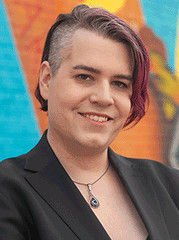
Scales was already living much of her life in the public eye before she decided to run for office.
A business owner and longtime media producer, Scales spent years hosting and producing Checkpoint XP – a nationally syndicated radio show focused on esports and video games – eventually helping to found Esports Illustrated, where she served as the publication's first editor-in-chief. Her work put her behind a microphone and in front of audiences long before she entered politics.
But Scales said her understanding of identity came more slowly.
She recalled knowing something felt wrong in her early teens, though she lacked the language to name it. As a young adult, she cycled through therapists who initially dismissed her distress as difficulty adjusting to college life. It wasn’t until she connected with a therapist who had a transgender child, she said, that she recognized her dysphoria — a realization Scales credits with saving her life.
When Scales began her transition, she faced a choice: Do it quietly, or do it publicly. She chose visibility.
At the time, she was already a radio host and podcaster with an established audience. Scales said being open about her transition exposed her to harassment, but also created moments of connection that reaffirmed her decision. Years later, receiving a message from a parent whose child had come out as transgender, they asked for guidance. It was that moment, she said, that made it worth it.
Scales’ career in media, she said, shaped how she views leadership. As a producer and editor, she prioritized creating space for others to tell their own stories — an approach she carried into her advocacy work and eventually fundraising for LGBTQ organizations such as Affirmations, Transgender Michigan and The Trevor Project.
Her decision to run for office also came after President Trump's inauguration. Scales said listening to the speech pushed her from advocacy into action. Within weeks, she joined the Michigan Democratic Party, became active in the Oakland County Democratic Party and helped revive its LGBTQIA+ rights committee.
Originally considering a school board run, Scales said she ultimately decided to seek a Michigan House seat when the opportunity arose.
“I didn’t plan on politics being the destination,” she said, “but everything I’d done up to that point prepared me for it.”
Aaron Bailey (D-District 92)

Bailey’s path to the ballot is the most recent and the most immediate.
Bailey, the youngest of 10 siblings, spent part of her early childhood in foster care before being adopted at age three. Later, her family faced financial hardship after her father was seriously injured in an accident, an experience Bailey said first sparked her interest in politics.
She remembers paying attention to national elections as early as middle school, watching debates about healthcare while her father was still recovering.
“That’s when it clicked,” Bailey said, “Politics wasn’t abstract anymore.”
Bailey began questioning her gender identity in 2024, realizing she had long felt disconnected from herself. Coming out, she said, felt less like a rupture and more like relief. At her workplace, she immediately asked to update her name tag and pronouns, hoping to lead by example.
Since then, Bailey said she has been navigating what she calls a delayed “girlhood” — small moments of affirmation that felt newly accessible. She recalled being invited into a women’s restroom by other political attendees at an event as one such moment.
Her decision to run came quickly after losing Medicaid coverage in August 2025, just days after filing campaign paperwork. The experience, she said, turned a personal setback into urgency.
“I realized someone needed to step up,” Bailey said, “and that someone was going to be me."
Toni Mua (D-District 9)

For Toni Mua, running for office is not new — but the weight of being first still lingers.
Mua ran for the Michigan Legislature in 2022, seeking the Democratic nomination in District 10. Though she fell short, she said the experience reshaped how she understood both leadership and visibility.
“There was a responsibility that came with it,” Mua said, “You’re setting a precedent for everyone who comes after you.”
Mua is the daughter of an immigrant nurse and an automotive plant worker, a background she said shaped her sense of responsibility and service. She holds an associate degree in business management, earned dual bachelor’s degrees in business administration and management from Oakland University, and later completed a master’s degree in public administration at Wayne State University.
She said coming out as a transgender woman was met with support from her family, but running for office added a new layer of scrutiny. She described receiving criticism rooted not in her platform, but in her identity.
Still, Mua said the experience reinforced her resolve.
“Before I ran, I was often the only trans person in the room,” she said, “I didn’t want that to keep being the case.”
Now running again, this time in Lansing’s District 9, Mua sees the current election cycle as a continuation rather than a comeback. She said watching more transgender women step forward, including the others in the Dollhouse, signals a shift she once hoped for.


