
Overflow Crowd Listens To Bills Limiting ICE's Abilities In MI
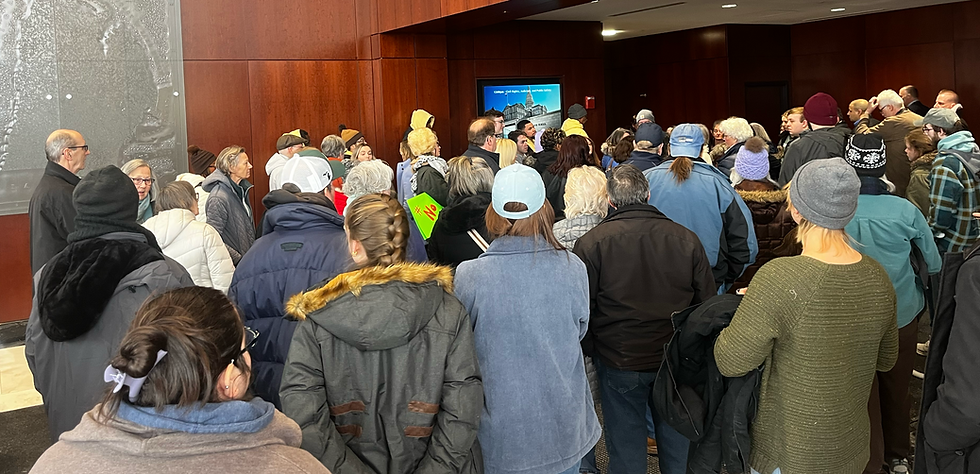
(Source: MIRS.news, Published 01/29/2026) The hearing room reached its maximum capacity as the Senate Civil Rights, Judiciary and Public Safety Committee continued testimony on bills aimed at limiting immigration enforcement's abilities in Michigan, like by outlawing masked officers and prohibiting public bodies from releasing personal information without court-issued warrants.
Testimony lasted nearly two hours. In the room were folks against the increased presence of the U.S. Immigration and Customs Enforcement (ICE) in Minneapolis, more than 630 miles away. The reported deployment of up to 2,000 agents into Minnesota – linked to federal efforts to crack down on social services fraud allegations against the Somalian community there – has involved large protests and resistance from bystanders.
This month, headlines have zoomed in on the fatal shootings of 37-year-old intensive care nurse Alex Pretti and 37-year-old poet Renee Nicole Good, reportedly by ICE agents.
Sen. Jim Runestad (R-White Lake), the committee's minority vice chair and the Michigan Republican Party chair, challenged the supporters of Thursday’s legislation, raising questions on whether claims against ICE were evidence-backed.
As the crowd stirred as he spoke, he called out the audience's "snarky comments and guffaws," calling the hearing a "kangaroo court." One testifier had her remarks cut off by committee Chair Stephanie Chang (D-Detroit) when she repeatedly called Runestad "Jimmy Runestad" negatively.
Meanwhile, Sen. Jeff Irwin (D-Ann Arbor) said he's concerned about the killings he's "seen in the street," but feels like there's more coming. He wondered if SB 510 – legislation prohibiting federal and state law enforcement from being masked or disguised outside of certain undercover and health-related reasons – could offer safety to officers themselves.
"It strikes me that if you have masked agents essentially carjacking people, invading homes – this is a situation in a heavily armed, Second Amendment-friendly country…that could result in great danger," Irwin said. "Not just for the individuals who are being abducted, but also for the folks who are working in immigration enforcement."
Irwin projects more deaths are coming, and "it's going to be on both sides, and I think that's tragic."
SB 508, SB 509, SB 510 and SR 86 are the bills that received testimony Thursday, after receiving an initial hearing in early November.
SB 509 would prohibit government entities in Michigan from responding to personal information requests they suspect will be used for federal immigration enforcement without there being a warrant by a federal or state court. Under the bill, government entities – like local government commissions or bureaus – must report to legislators and the Attorney General about how many requests they've received.
SB 508 prohibits immigration enforcement from taking place outside of places of worship, funerals and weddings, hospitals, courthouses and schools.
Although state lawmakers are limited in their abilities to influence federal agencies, they can attempt to restrict ICE through regulating how local law enforcement cooperates with them and reducing access to state property.
SR 86 is a resolution by Chang calling on Congress to pass federal legislation requiring immigration officers to display visible identification, prohibiting face coverings and minimizing enforcement in "sensitive locations" like schools, healthcare facilities, courthouses and public assistance offices.
One of the testifiers was Lindsey Matson, the Detroit-based deputy director of youth organizing at 482FORWARD, which collaborates with neighborhood groups and households to ensure Detroit youths learn successfully.
Matson said she's personally worked with youths detained and deported this past year, as well as children whose parents have been deported. She relayed an anonymous letter from a student at Cass Technical High School, who said her parents barely let her leave the house after school because they were worried about her safety.
Because agents can cover their faces and not clearly wear badges, Matson said the high schooler is concerned about "how would we know if we're being kidnapped or taken by ICE?"
She also laid out testimony from Kristen Schoettle, an English-as-a-Second-Language teacher at Western International High School in Detroit. Matson said that Schoettle has had five students removed by ICE, plus dozens of students whose family members were arrested.
"'My student's house was raided at 5 a.m. with guns pointing at her because ICE was looking for a friend of her aunt's who doesn't even live there and never has. This child is still in a prison in Texas two months later,'" Matson said, reading Schoettle's letter. "'Our streets are not safe, Our schools are not safe. We live in fear everyday.'"
Another supportive speaker was Austin Lowes, the elected chair of the Sault Tribe of Chippewa Indians. As a tribal community on the United States-Canada border, he said that immigration and border enforcement efforts are common in their surrounding communities.
However, he explained the relationship between the tribe and federal and state partners is "built and nurtured on transparency and the rule of law."
"I must point out that the irony that tribal communities are now being forced to demonstrate their citizenship in a country where we're the first residents is not lost on us," Lowes said. "A lot of our membership has darker skin than I do...and they're filled with anxiety at this time, because the way that ICE is currently operating, they're operating based on racial profiling…if you have dark skin that could confuse you for maybe someone of Hispanic heritage, you can be racially profiled."
He said that tribal governments have been issuing more tribal IDs.
There was an opponent to Thursday’s bills, Shari Rendall of the Federation for American Immigration Reform (FAIR), which has been scrutinized for accusations of promoting pro-white racism.
Requiring officers to wear masks with uniforms displaying names and badges would, according to Rendall, interfere with ICE's ability to operate safely and would demonize officers.
She described reports this past week of hotels, amid the Minnesota demonstrations, being "swarmed" by anti-ICE protesters believing officers were lodging there, "using the F-bomb" and allegedly blocking entrances with vending machines.
She added that there is no indication that immigration officials currently conduct general or exploratory raids at "sensitive locations," but rather they utilize "discretion and good judgment" to seek out a specific, targeted individual.
"Officers entering these locations seek to minimize enforcement impacts by ensuring their actions are discrete," Rendall said. "Courthouses are not sensitive locations. ICE knows that individuals in locations like a courthouse are unarmed. It is safer for the individual and it is safer for law enforcement. It is safer for them to take someone into custody there."
Also on Thursday, Progress Michigan, the communications team and media hub for progressive politics, released polling on federal immigration policy following the deaths in Minnesota.
With a 748-person sample of Michiganders, it found that 51 percent disapprove of the job ICE is doing, 82 percent have seen a lot of content about the civilian deaths in Minneapolis and 54 percent believe President Donald Trump is focusing too much on deportations and not enough on fixing the economy.


