
Democratic Primary Sees Highest Turnout In MIRS' 44-Year Review
(Source: MIRS.news, Published 08/07/2026) Nearly 1.5 million Michiganders cast votes in the Democratic gubernatorial primary Tuesday, driving the party's highest primary turnout as a share of registered voters in more than four decades.
About 1.49 million votes were cast in the Democratic gubernatorial contest compared to 929,172 in the Republican race Tuesday, according to a MIRS analysis of primary election results and statewide voter registration numbers dating back to 1982.
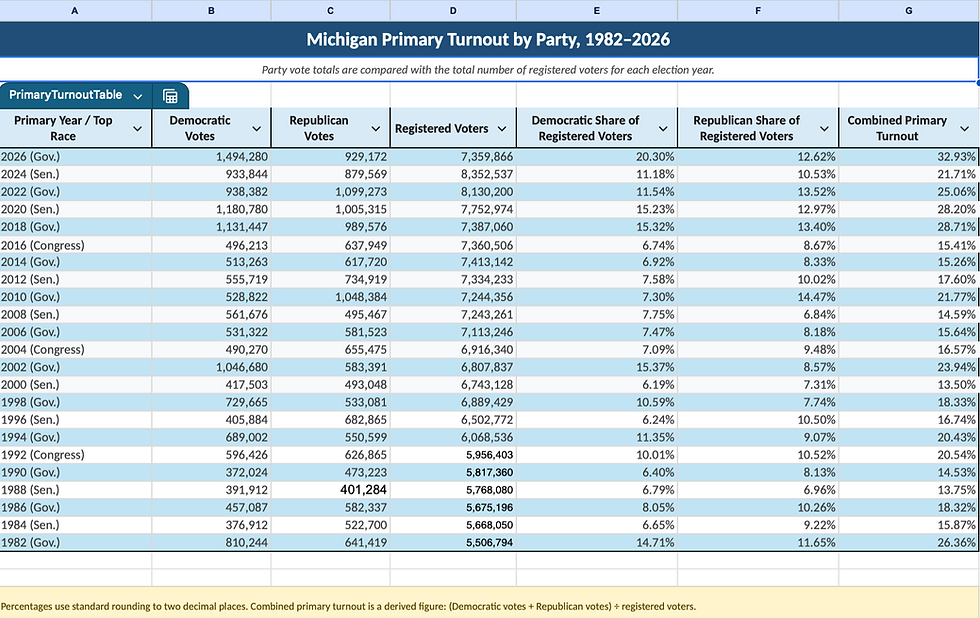
Democratic votes accounted for 61.7% of the votes cast in the two parties’ top-of-ticket primary races, compared to 38.3% on the Republican side.
The Democratic vote total was equivalent to 20.3% of Michigan's 7.36 million registered voters, the highest percentage in the 44-year period reviewed. Republican votes represented 12.62% of registered voters. Combined, votes in the two parties' top races were equivalent to 32.93% of the state's registered voters, also the highest figure in the period examined.
Prior to this year, the highest Democratic share in the MIRS review came in 2002, when Democratic primary votes amounted to 15.37% of registered voters. About 1.05 million Democratic votes were cast that year.
Despite the race not being at the top of the ticket, the surge in Democratic voters could have been driven in part by the U.S. Senate race between former Wayne County health director Abdul El-Sayed and U.S. Rep. Haley Stevens (D-Birmingham), which garnered considerable national attention and broke the record for the largest spending in a single Democratic U.S. Senate primary in American history.
Andrea Bitely, of Bitely Communications and a moderate Republican commentator on this week's MIRS Monday Podcast, said one of her observations ahead of the primary was that Democrats were “more angry than we're giving them credit for,” pointing to frustration she had heard from voters who felt Democratic elected officials were not fighting back hard enough against President Donald Trump or delivering enough to their communities.
Jessica Newman, a Democratic Socialist also appearing on this week's podcast, pointed to El-Sayed's wins in Bay City, Warren, Troy and the Upper Peninsula. She said El-Sayed had held roughly 520 events statewide, including more than 100 outstate, and described his campaign message as focused on “money out of politics, money in your pocket, Medicare for all.”
The numbers offer some context to the speculation following Tuesday's election that Republicans may have crossed over to participate in consequential Democratic primaries.
Because Michigan does not require voters to register by party, primary voters can choose either the Democratic or Republican ballot, although they cannot vote in both parties' races.
Bitely said she believes some crossover voting likely occurred, but not at a scale large enough to explain the Democratic turnout.
“I don't think it's too large of a number,” Bitely said in a sneak peek of the podcast.
Bitely said Republicans had less drawing them to the polls this year. She described the Republican gubernatorial contest between U.S. Rep. John James (R-Shelby Township) and Perry Johnson as largely settled heading into Election Day and noted there were relatively few competitive Republican congressional primaries.
“There really wasn't that interesting of a ballot, and I think you saw that in Republican turnout numbers,” Bitely said. “We just didn't show up for the primary because there wasn't a whole lot going on.”
Bitely said it was possible some Republicans attempted to influence Democratic contests, pointing specifically to Republicans who may have viewed 7th Congressional District Democratic nominee Will Lawrence as an easier matchup for U.S. Rep. Tom Barrett (R-Charlotte), or El-Sayed as a preferable general election opponent for Republican Mike Rogers.
“Was it a high number? No, I don't think so, anyway,” Bitely said. “But you've always got some people that cross over. I'm sure there was probably a Democrat somewhere in the state that decided to cross over and vote on the R side at some point in their lives."


