
Abdul Detroit Event Interrupted By Man Shouting 'He's An Arab, He Don't Care'
(Source: MIRS.news, Published 08/19/2026) (DETROIT) – A disruptor briefly attempted to interfere with an event where Democratic U.S. Senate nominee Abdul El-Sayed was trying to engage with voters Downtown, shouting, "He's an Arab, he don't care about Black folks."
The disruptor could be heard for about three minutes during El-Sayed and the Michigan Democratic Party's event in front of the Spirit of Detroit monument on Woodward Avenue. Campaign personnel blocked him from getting closer to the podium, and eventually he walked away toward the RiverWalk.
The encounter illustrated a challenge El-Sayed faces heading into November: Connecting with Black voters, particularly seniors, in Detroit and Wayne County.
U.S. Rep. Haley Stevens (D-Birmingham) won Detroit in Democrats' U.S. Senate primary by more than 28 percentage points, and by nearly six percentage points in Wayne County overall.
Sam Robinson of the Detroit one million media project brought up to El-Sayed how, when it comes to the man's comments, "I hate to say this, but I continue to hear it from older Black folks."
"There's been an effort, I think, to divide people against each other, and unfortunately, you see (the) consequence of that, to tell us that some group or another group have to be counterposed because there's not enough for all of us," El-Sayed said. "My family immigrated to this country from Egypt. I'm proud of my African heritage, and when people try to divide us based on identity or ethnicity, sometimes we miss the nuances that make us whole and that make us human."

He said he would love the opportunity to sit down with the gentleman, wanting to "understand his perspective and what he fears."
At the end of the day, El-Sayed described that he wants the man to have access to his proposed "Medicare for All." He also wants his DTE Energy and Blue Cross Blue Shield bills to not be inflated when "our government is bought off" by corporate spending in politics, which El-Sayed is against.
"I care that he has a union just like everybody here deserves a union," El-Sayed said. "I hope someday I (will) get to sit down with him. I'm sure we'd have an amazing conversation."
El-Sayed also pointed to his tenure as Detroit's health director from 2015 to 2017 as evidence of his connection to the city, saying he has “a long story to tell about my commitment to these communities.”
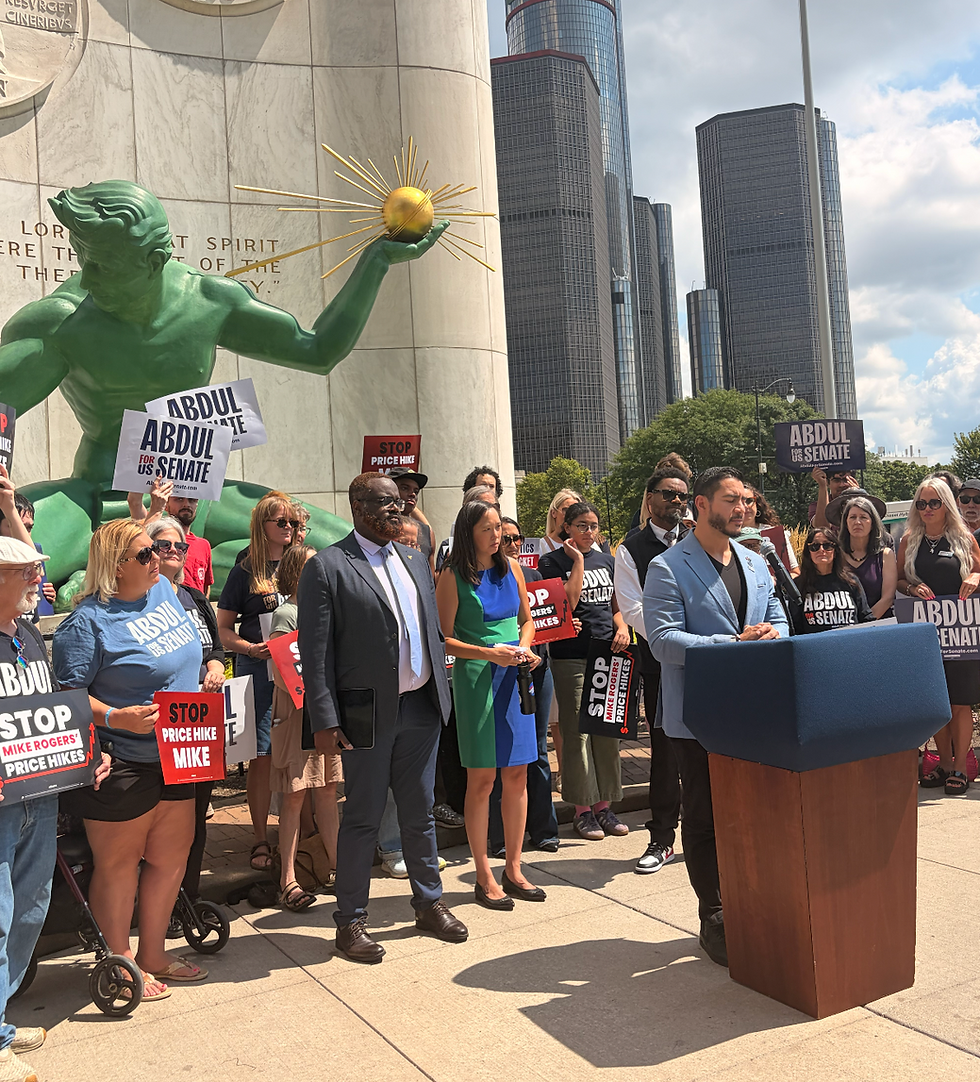
Participating in El-Sayed's campaign event was Detroit City Councilmember Denzel McCampbell, who defeated state Rep. Karen Whitsett (D-Detroit) last year to represent the city's 7th district.
McCampbell addressed issues of Islamophobia that have come up in front of city council members.
"We have to reject the hate and reject Islamophobia, and understand that it's not that we're fighting against each other…or even, as I've heard, like communities in Detroit and Dearborn are fighting against each other," McCampbell said, mentioning the Black-majority city of Detroit and Dearborn, which has one of the country's largest Muslim populations.
He said more money is needed for the neighborhoods, and "what I'll tell folks that are listening, especially Black Detroiters, is that Mike Rogers is not going to have Detroit in mind when he's in the U.S. Senate."
Speakers also sought to turn the event back toward Rogers, arguing that the Republican nominee's record on Detroit, health care and corporate interests was out of step with the city.
They talked about pharmaceutical industry donations Rogers received as opioid addiction was rising; El-Sayed accused Rogers of leaving the U.S. House after 2014 with a $14.6 million net worth made by "trading on the relationships he built while he was a congressman from this state."
"And he took that money, and he moved to Florida, bought a McMansion and one yacht wasn't enough for the man, he had to buy two of them. I mean, you can only be on one yacht at a time. Am I wrong? What (did) you need the second one for?" El-Sayed said.
Following the event, MIRS spoke with Daune Gholston, a 35-year-old political content creator, transit activist and El-Sayed backer from Detroit's west side.
Gholston said some of the resentment among Black Detroiters toward Arab and Chaldean communities stems from the ownership of gas stations and liquor stores in some of the city's poorest neighborhoods.
"All the people that live there are not running them. It is weird. So they do have resentment," Gholston said. "That man screaming never said a single word about policy … I've been interacting with people who have that same mindset as him. Their opinions have nothing to do with policy, ever. They can't name a policy."
Gholston described such attitudes as a combination of prejudice and low-information voting.
He also wants El-Sayed's campaign to do more events where there are passing-by attendees, everyday people who aren't really tuned in.
"I got 100 stacks of these flyers. I'm going to pass out 100 of them today. I'm going to stand outside from the grocery store to the dollar store, whatever," he said. "Don't focus on the haters."
However, Tuesday evening, at the kickoff of a coalition called "Black Voters for Benson," union organizer Jima Thomas-Gilbert said she's waiting to hear back from El-Sayed about having an event with him at her house.
Thomas-Gilbert is a 55-year-old resident of Detroit's Russell Woods neighborhood, returning to Michigan after spending 23 years living in Washington, D.C. and Baltimore.
"If he shows up, that will say a lot. There's a hard conversation that needs to be had because I think a lot of why Michigan went red (in 2024) is because a large segment of this population sat out in protest," she said.
She was referring to residents who didn't vote for then-Vice President Kamala Harris in protest against Israeli military actions in Gaza and the United States' ties to Israel.
El-Sayed openly participated in the "Uncommitted" movement during the February presidential primary in Michigan, months before President Joe Biden suspended his reelection campaign. El-Sayed later did endorse Harris.
However, some Detroit operatives argue that more should have been done to urge voters to support Harris – who could have been the first Black female president – and pull the plug on the movement.
"I'll invite you to my table because my table comes with the neighborhoods, so if you really want to have the hard conversation and talk about how we move together forward, because we have to move together forward," Thomas-Gilbert said. "We understand that we definitely need to vote our own self-interest and their interest, and then we come together."


